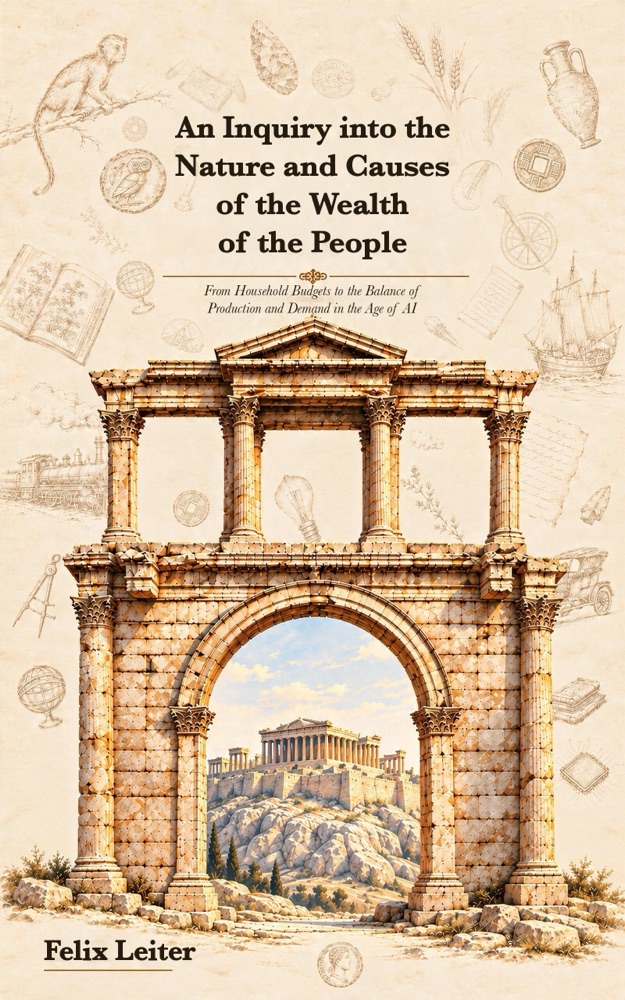
International Edition
An Inquiry into the Nature and Causes of the Wealth of the People
From Household Budgets to the Balance of Production and Demand in the Age of AI
Productive capacity keeps rising. Why are ordinary people not becoming prosperous with it?
The book
Daniel and Emily both work, and by the standards of their North American city they are not poorly paid. They take home $10,300 a month. Once the mortgage, childcare, food, commuting, insurance and medical costs are paid, $1,400 is left, along with about ten usable hours a week. The city grows richer every year; their margin does not.
In 1776 Adam Smith asked where the wealth of nations comes from. Two hundred and fifty years later, as artificial intelligence begins to take over cognitive work, this book asks the same question of ordinary people. A gain in productivity can become cheaper goods, higher pay, larger profits or shorter hours. Technology creates the gain; it does not decide where the gain goes.
The book separates wealth, what a society produces, from prosperity, the money, time and security left in an ordinary life once the essentials are paid. It measures prosperity with a generalized Engel coefficient and the hours of work the essentials cost, and shows that prosperity forms only in exchange among a society's own people: one person's discretionary spending is another's income. Trade, printed money and conquered resources cannot stand in for that circuit.
It then places politics and economics in one frame. Whether a person can do something depends both on whether it is permitted and on whether it is affordable. From there the book treats the range of fair prices, the pure producer, education, the decay of economies and of power, public finance, a market built on morality, and why the age of AI, like the age of the factory acts, needs a boundary drawn around working time.
It is written for general readers. No prior training in economics is needed.
One theory, two editions
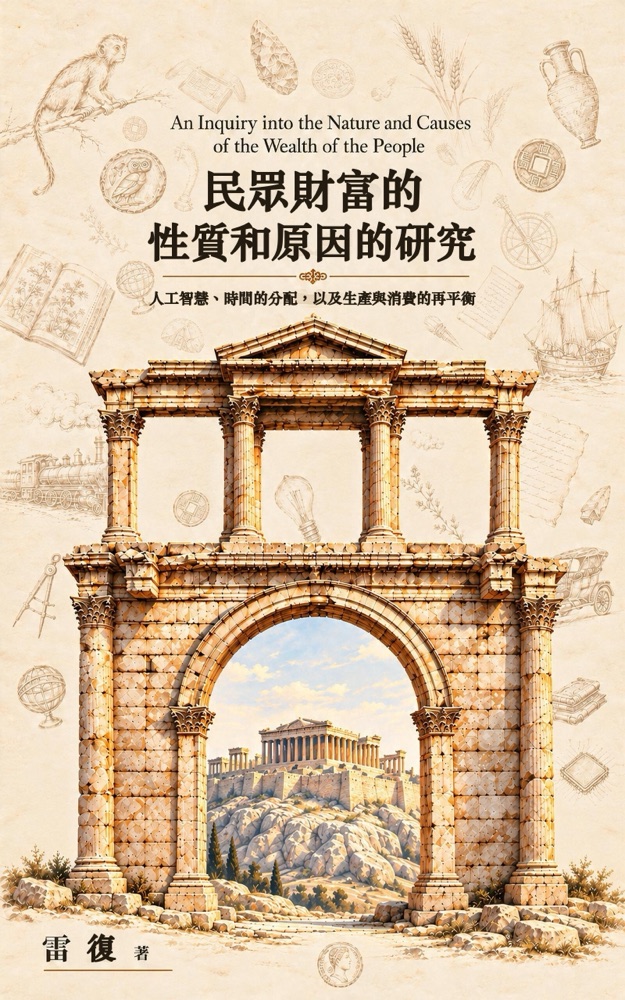
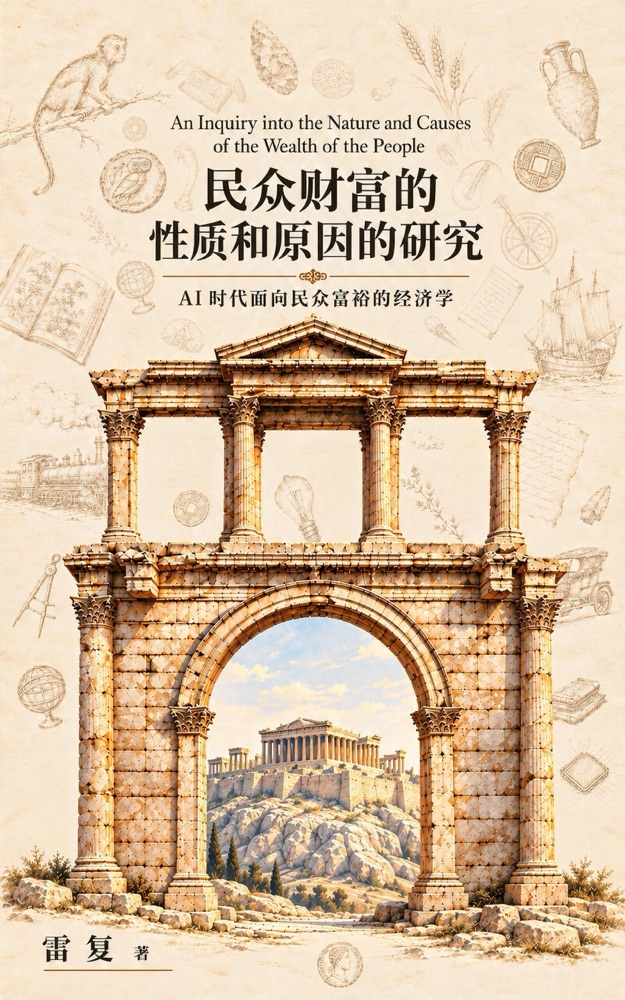
The book exists in a Simplified Chinese edition written for readers in mainland China, and in this International Edition, with its own Western setting, published in English and Traditional Chinese.
Contents
- Preface
Part I · The Problem
- 1A Household Budget
- 2Three Events in 1776
- 3Wealth and Prosperity
Part II · Measurement and Price
- 4Why Printing Money Cannot Make the Poor Prosperous
- 5The Generalized Engel Coefficient
- 6The Pure Producer
- 7The Hours Inside a Price
Part III · The Making of Prosperity
- 8One Person's Spending, Another's Income
- 9Education and the Art of Living
- 10Prosperity from Within
- 11Self-Repairing and Brittle Economies
- 12Two Equilibria
Part IV · Power
- 13Rights, Power, and Starting Over
- 14The Metabolism of Power
- 15Taxes, Public Finance, and the Wealth of the People
Part V · Applications
- 16Who Gets the AI Dividend
- 17Why Conquest Cannot Make a People Prosperous
Part VI · Interface and Synthesis
- 18Where Politics Meets Economics
- 19A Market Built on Morality
- 20What Would Make Ordinary People Prosperous
Appendices
- Glossary
- Notes on the Argument
- References
Buy the book
Ebook editions will be listed here as they go live.
Support this work
If the book has been useful to you, you can support further work on it.
[Donate by card: Ko-fi link]
Contact
For readers, editors and rights inquiries: books@thinkingineconomics.com